General tarot readers on YouTube brought the associations between tarot cards and astrological signs to my attention. General readings are, often, identified as specific to an astrological sign or all signs: Aries, Taurus, Gemini, etc. As I listened, it was apparent that readers identified certain tarot cards with other zodiac signs. For instance, “Hierophant, sign of Taurus,” “Libra, you’re in your own reading, the Justice Card,” and “The Devil, sign of Capricorn.”
Such tidbits of information prompted a deeper look into this topic and resulted in the The Grand Graph of Tarot and Astrology Complements With Dates that was soon followed by a table depicting the same information. Both are available here – graph and table. I derived these from descriptions in two books based on the late 1800’s writings of the Hermetical Order of the Golden Dawn, a London-based secret organization that studied and documented oral traditions in topics such as magic, tarot, astrology and Hebrew mysticism. The two books are: Corrine Kenner’s Tarot and Astrology and Robert Wang’s An Introduction to the Golden Dawn Tarot.
Without really intending to delve further into the subject, a new doorway was opened to me quite unexpectedly – the Brotherhood of the Light, a U S based source of tarot history somewhat contemporary with the Golden Dawn but far more open to the public dissemination of what had been secret information. The Brotherhood of the Light operated in Los Angeles, California, in the early 20th Century. The Brotherhood and we are much indebted to one prolific author Elbert Benjamine (aka C. C. Zain) for sharing this information in highly readable books. He also founded the successor organization, The Church of Light, whose website offers classes and many, if not all, of Zain’s “over 50 books and thousands of magazine articles.” (1)
Zain begins The Sacred Tarot with a description of “kabala” – the written and the unwritten. Zain attributes a definition of unwritten kabala to the Golden Dawn author S. L. MacGregor Mathers, who describes it as “The term . . .applied to certain knowledge which is never entrusted to writing but communicated orally.” (1) Mathers would say no more than that; Zain, thankfully, has no such compunctions against sharing the secrets which are, in fact, traditional knowledge handed down from all lands and peoples.
Zain writes,
The unwritten kabala has been transmitted only through certain ancient secret schools. Those receiving it well merit what is given to them. They are left to their own devices in the matter of interpretation. And because the real keys to its interpretation – astrology and the tarot – have been largely ignored, or distorted, they have floundered sadly in arriving at its meaning. (1)
The teachings to which he refers is a collective body of philosophy correlated to “esoteric astrology as exemplified by the tarot.” (1) In other words, the tarot functions as a way of interpreting the energies arising from planetary sources – the tarot is a pictorial representation of the planetary energies. In today’s parlance, the tarot cards are representations of the planetary archetypes – NOT the gods and goddesses of Greek mythology – today’s archetypes represent the “deepest pattern of psychic functioning, the roots of the soul governing the perspectives we have of ourselves and the world.” (2)
Knowing that astrology and the tarot are two parts of the same system linked by energy and its archetypal imagery, the question becomes, just how far back in time does this association extend? The answer amazed me.
Many tarot historians date the tarot from the 15th Century cards that appeared first in Italy then spread to France and England, among other countries. This version of the tarot was a parlor game, and is often described as the beginning of the “modern” tarot. I prefer to think of it as a stage in the long history of the tarot and the beginning of its public emergence.
From the broad definition of kabala, Zain follows the thread of the Jewish Kabala and tells us that there are three versions within that doctrine: practical, literal and dogmatic. It is the Dogmatic Kabala that led me to The Sephir Yetzirah aka The Book of Formation, which includes the 32 Paths of Wisdom that describe the astrological/ tarot system of antiquity – I am unsure at this point whether this astrology/tarot system is still in use in the Jewish community.
This early version of the astrology/tarot system is divided into two parts. The first is composed of the four Aces and the sets of four cards numbered 1 – 10 that are identified as The Transcendental Decad (group of 10). These represent the first through the 10th paths of wisdom. The second part, the “Major Arcana,” is further subdivided into three parts: The Perfect Triad (group of 3), The Holy and the Averse Heptad (group of seven – the planets), and The Constant Dodecad (group of twelve – the astrological signs). (4)
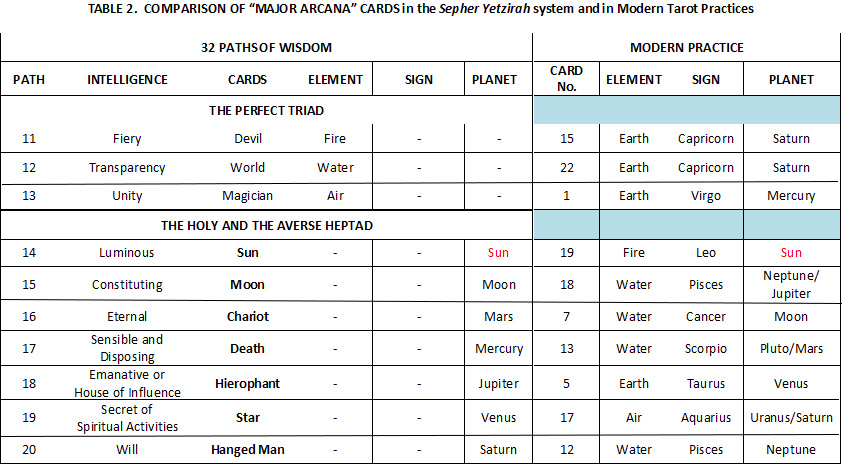
The Perfect Triad is three cards and their given elements: the Devil (Fire), the World (Water) and the Magician (Air). These represent the 11th through 13th paths of wisdom. The elements associated with these cards differ from that ascribed to them in modern tarot practice in which all three of these cards are associated with the element of earth.
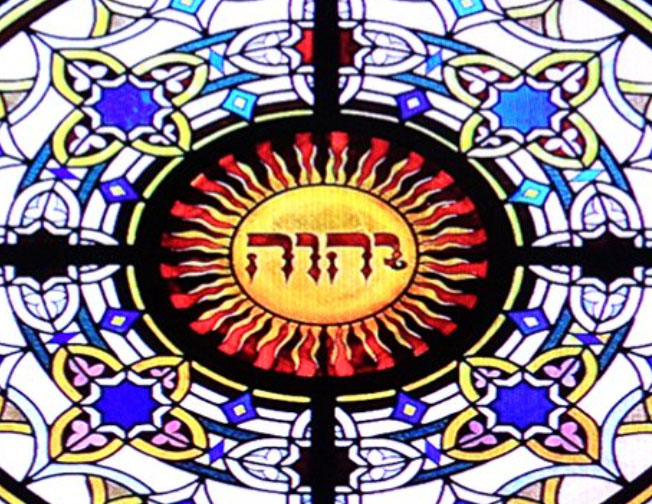
Court Cards are closely associated with the four-letter theonym, in this text IHVH, that forms the Tetragrammaton, also known as the Jewish name of God, Yahweh, or the Latinized version Jehovah. See Table 1, below.
| I Coition | H Sight | V Hearing | H Sight |
| Love Wands (Clubs) Knight | Empress Cups (Hearts) Queen | Emperor Swords (Spades) King | Child Pentacles (Diamonds) Page |
| Air | Water | Fire | Earth |
Note that the elemental associations for the Wands and Swords are reversed as compared with elements for these suits in the modern tarot where Wands are the element of Fire and Swords are the element of Air.
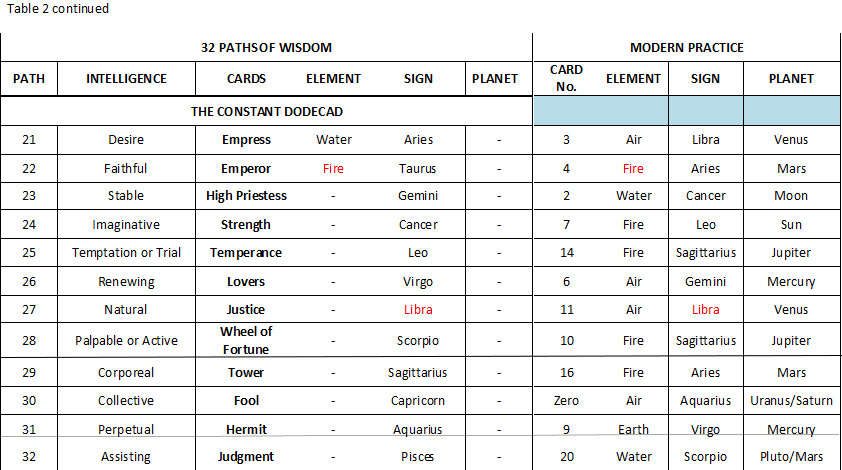
Planetary assignments apply to the The Holy and The Averse Heptad – the 14th through 20th paths of wisdom and astrological signs apply to The Constant Dodecad- the 21st (Aries) through 32nd (Pisces) paths of wisdom. (4) Table 2, below, compares the cards that would be considered the Major Arcana – those depicting life level changes or lessons. While, the card names are consistent with those used today, based on this translated version of The Book of Formation, you will see that beyond that there is little consistency of element, sign, or planetary associations. Naturally, some of the planetary inconsistencies may arise from the fact that there were only seven known planets in antiquity and modern astrology assigns two planets to some signs. The consistent items are marked in red in both tarot systems.
An outstanding difference is that The Fool in the 32 Paths of Wisdom system is designated by the Hebrew simple letter “O” that has somehow been translated into a zero in the modern tarot. The numerological significance of this is remarkable because the letter “O” represents the number 70.
There is, of course, much more to explore in the 32 Paths of Wisdom’s astrology/ tarot system. I have not even begun the numerological comparisons and of course the modern tarot has no letter associations at all. Nevertheless, an upcoming blog will explore the transformation from the mystical tarot of antiquity to the predictive tarot of today. Corrine Kenner tells us, “In 1785, the French occultist Jean-Baptiste Alliette devised a full-fledged set of correspondences between astrology and tarot.” (5) This seems like a good starting point in the exploration of a transformation.
So, again, just how far back in time does this association extend? The short answer comes from Zain who attributes this information to “seriously informed commentators.” (6) The legend is that The Dogmatic Kabala was first taught by God to his select angels who formed a school in Paradise. After the fall, this doctrine was provided to man in the belief that it might assist in re-establishing our lost estate in Eden – but it apparently did not. From there, the Jewish line of doctrinal succession includes Noah, Abraham, unidentified Egyptian adepts who, eventually, passed it on to Moses, (6) – and very likely to selected others.
Still, the Masters teach that God is a LAW, the Creative Principle. So then WHO passed that information to the selected “Angels?” Now, all you have to do is look around to see that the world is filled with examples of highly complex inspirations that manifested into the 3rd dimensional reality. Engineering is a primary pathway for this in today’s world.
Yet, the zodiac is reported in the Sumerian creation “myth” as one of the “gifts” from a culture that once lived on Earth with us. Might there be a link between the Jewish and Sumerian creation stories? Yes, there might. I’ve found a dissertation that explores this very question, here’s an excerpt from the Abstract:
Although some late 19th and early 20th Century scholars proposed that the Israelite god Yahweh is a form of the Sumero-Akkadian god Enki/Ea, this theory was quietly abandoned in the scholarly reaction against “Pan-Babylonism,” and has not been revived since that time. In light of new knowledge gained over the past century, this theory deserves a fresh, comprehensive argumentation on its behalf.
The primary basis for the idea that the biblical god (considering both Yahweh and his incarnation in Jesus) is a form of Enki/Ea lies in the considerable congruency between the theological traditions of these gods, which encompasses divine names, functions, values, and character traits; literary themes; mythic images; ideologies; cultic forms; and socio-historical circumstances. . . Among the challenges the argument faces is that of bridging the gap between polytheism and monotheism, a task aided by evidence of significant residues of polytheism in the biblical tradition, as well as of the monolatrous character of the Enki/Ea tradition. The principal other Sumero-Akkadian god who appears to be implicated in biblical religion is Dumuzi/Tammuz, a son of Enki/Ea and a personification of the planet Mercury. (7)
I’m looking forward to reading this work and will report in another blog what the author found. ‘Til then, this discussion must end with, “TO BE CONTINUED. . .”
REFERENCES
- C. C. Zain, aka Elbert Benjamine, 1936. The Sacred Tarot. Brotherhood of Light, 1936, now CofL Press, the Church of Light, page 7.
2. James Hillman, as quoted in, Cosmos and Psyche Intimations of a New World View, by Richard Tarnas, PLUME/ Penguin Group publication, New York, NY, May 2007, page 83.
3. Rabbi Akiba Ben Joseph, The Book of Formation, Sepher Yetzirah, 1923. Martino Fine Books, Eastford, CT, 2019, p 37.
4. Rabbi Akiba Ben Joseph, The Book of Formation, pp. 54-62.
5. Corrine Kenner, Tarot and Astrology Enhancing Your Readings With the Wisdom of the Zodiac. Llewellyn Publications, Minnesota, 1964, Thirteenth Printing 2021, p. xi.
6. C. C. Zain, aka Elbert Benjamine, 1936. The Sacred Tarot. Brotherhood of Light, 1936, now CofL Press, the Church of Light, page 9.
7. Tony Ormond Nugent, Star-god: Enki/Ea and the biblical god as expressions of a common ancient Near Eastern astral-theological symbol system. Syracuse University, 1993, doctoral dissertation, Abstract. Available on April 9, 2022 at: https://surface.syr.edu/rel_etd/52/.
Rev 0, April 9, 2022. Approved for use.
 Marjorie's Writings